Showing posts with label NFL. Show all posts

Friday, December 12, 2008

Competition is what drives all of us

Like Nick Saban at Alabama and Tony Sparano in Miami, Ken Whisenhunt "has succeeded where so many others have failed. He built a playoff team in Arizona, transforming an NFL wasteland into an NFC West champion in just two seasons."

As outlined in this story, Coach Wisenhunt has an interesting back story.

A walk-on at Georgia Tech back in the '80s, he went on to become the school's second all-time leading receiver in yards. He played for nearly a decade in the NFL despite being the 313th pick (of 336) in the draft.

That underdog, overachieving mentality has shaped his coaching philosophy:

"I always had to make the team, I always had to work to play," he said, "and part of that is my philosophy about how we treat our team. You have to earn the right to play. A lot of it is based on how they perform in practice and what you see out of them in their preparation and any competitive situations that they're in. Competition is what drives all of us, and what these players really thrive on."

During the course of his coaching career, he's worked for Dan Henning, Joe Gibbs and Bill Cowher. "I've taken something from all of them," he said. "[They] shape[d] a lot of things that I think and react to."

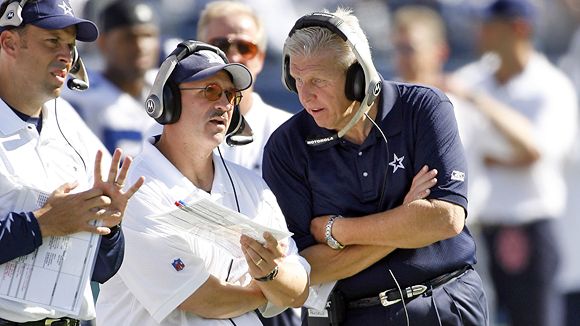
Says QB Kurt Warner (pictured above with Coach Whisenhunt):

"A quiet confidence is I think what he's brought to this team more than anything. He showed us very early on that he believed in us, that he believed in this organization and what we could accomplish. Players and the organization might not have believed it, but he brought it in and believed it from day one, and slowly it starts to seep in, and guys start to believe it and then you take it to the field, and it starts to show up on the field."

Wednesday, December 10, 2008

Having the courage to try something new

After going 1-15 last season, new Dolphins coach Tony Sparano started off 0-2 as head coach in Miami.

It was at that point that he made the bold decision to try something different: "the direct-snap-to-a-running back, sleight-of-hand Wildcat formation."

In the 76 times the 8-5 Dolphins have used the formation this season, they've gained more than 450 yards and scored eight touchdowns.

Recalls Coach Sparano:

"We were all miserable at that point. I didn't feel like we had an identity in the run game. I also felt it was getting harder to put Ronnie Brown and Ricky Williams in the game at the same time and get them touches.

"I called [offensive coordinator] David [Lee] ... and said, 'Look. Here's what I want: Tomorrow when we get back, I want three runs, maybe a pass out of this Wildcat package … We need to find something we can put our arms around as an offense that can create space."

Of course, the "Wildcat Formation" isn't new. According to this article, it's "legendary coach Glenn "Pop" Warner's 1907 single-wing formation designed for multi-faceted, future Hall of Fame halfback Jim Thorpe. The last single-wing tailback to win a Heisman Trophy was Princeton's Dick Kazmaier in 1951. Kazmaier watched highlights of the Patriots befuddled by galloping ghosts."

"My reaction was one of amusement that something from 57 years ago would be resurrected and create a spark," Kazmaier, 78, says. "The single wing is a timeless treasure.

Adds Miami QB Chad Pennington:

"It goes to show the fundamentals of football never change, that the importance of blocking, tackling and executing never changes. You have to give coach Sparano credit for having the courage to bring something to the pro game that hasn't been done in a while. It creates good angles for the offense."

Since MIA unveiled the "Wildcat," a number of other NFL teams have introduced their own versions of the formation.

"It's all part of what makes this game exciting, coaches and players constantly trying to get an advantage," [Cardinals coach Ken] Whisenhunt says. "Defensive coordinators have to spend time working on it in practice. That's what you want, make them take time away from preparing for your base offense."

Coach Sparano is quick to deflect praise, saying: "We didn't invent it. We copied it from a college team."

Honoring a mentor and friend

Read in Gwen Knapp's column yesterday where 49ers coach Mike Singletary, following his first win as a head coach recently, drove over to the home of Mike Nolan -- the man he'd replaced as head coach a few weeks earlier -- and gave him a game ball.

"I wanted to make sure that I let him know that I am always indebted to him as a friend and as a mentor."

In the same column, I learned that, "shortly after taking the interim job, [Coach Singletary] persuaded the 49ers to hire Ron Blum, a retired NFL official, and install him as an adviser in the booth upstairs."

When Singletary explained the decision to hire Blum, he sounded very much like an ardent and curious student of the game. He said he had started thoroughly reviewing the NFL rules a few years ago, and called referees and visited at least one, trying to get inside their heads.

"It's so gray that you begin to think, 'You know what, I need to go about this in a different way. I need to have someone around me who has some awareness that can explain some of these rules. Because I know what the rule is, but then it's ruled differently. Either I'm going to drive myself nuts trying to figure this out, or you get someone who speaks that language."

Thursday, December 4, 2008

A formula for success

Since Mike Singletary took over as coach of the Niners in October, he's emphasized five "tenets."

According to this article, Coach Singletary's "49ers Formula for Success'' includes five principles such as "execution," "field position," and "finishing."

To make sure his players are getting the message, "Singletary also is hanging ... banners [with the forumla] around the building. And just before the end of practice, a team employee hauls a large signboard with the five rules onto the field."

By keeping it simple -- five clear principles -- and reiterating it every day at every interaction with his players, Coach Singletary is making it clear what he values and what his players should focus on.

Tuesday, December 2, 2008

Philosophy over celebrity

Former NFL All-Pro defensive end Fred Dryer talks candidly when outlining a plan for turning around the football program at San Diego State, his alma mater, which went 2-10 this season and recently fired its coach.

According to Dryer, it's simpler than it seems.

"It looks complicated when you have all the parts spread out on the garage floor. Once you get all of them in the right spot, putting everything together is pretty simple."

Dryer offers three rules for turning around the program.

First, philosophy is far more important than celebrity: "Hiring a big-name coach does not guarantee success. It's a combination of things, and I think it starts with analyzing the conference we play in and how to beat the teams within it. I've always wanted to have a coach here who's very aggressive, with a lot of energy on the recruiting trail. If you look in the candidate pool and shop for character guys with that pedigree, I think you have the greatest chance of success."

Second, focus on defense: "You must be able to dominate defensively if you want to beat the best. It might be fun to watch, but you cannot sustain success if you're in a shootout every week. What you want is a head coach who can build a powerful, dominating defense. He can delegate offensive responsibility to an assistant, which in turn makes the offensive coordinator job very attractive."

Finally, re-establish a killer instinct: "This will date me, but it goes back to something that Don Coryell (pictured here) told me years ago at San Diego State. He said, 'The object of this game is to break your opponent's will as quickly as possible.' Everything about a team... philosophy is wrapped into that statement."

Monday, December 1, 2008

A willingness to listen

Good story in the Minneapolis Star-Tribune yesterday about Vikings defensive coordinator Leslie Frazier, a member of the Bears' 1985 Super Bowl team who began his coaching career at tiny Trinity College outside of Chicago.

Coach Frazier played for Buddy Ryan in Chicago and was an assistant on Tony Dungy's staff in Indy when the Colts won Super Bowl XLI.

According to the article, "Frazier's coaching philosophy was shaped by two men in particular: Dungy and former Bears defensive coordinator Buddy Ryan. Both coaches left lasting impressions on him in terms of strategy and managing players. Though his low-key personality stands in stark contrast to the fiery Ryan, Frazier said he's tried to emulate Ryan's willingness to listen to his players."

"As great as he was as a coordinator, I think one of his greatest strengths was he would listen to us as players," Frazier said. "We would be in the middle of the game and I would say, 'Hey Buddy, I feel more comfortable if I could do this versus that.' He would go, 'Just make it work.'

As a player, when a guy says something like that to you as opposed to being rigid and saying, 'This is the way I want it. You have to do it that way,' you respond and you want to make it work because he's empowered you.

So when Jared Allen or Ben Leber comes to me and asks, 'Can we look at this. Is that all right?' -- for me to be so rigid and not listen, that would be a contradiction to what I saw from a guy who I think is one of the greatest defensive coordinators in National Football League history."

According to Coach Frazier, coaching is more than simply developing a game plan:

"It's important that the guys who are in leadership... that we really have to lead from an emotional standpoint as well and not just X's and O's. Brad [Childress] talks to us all the time about that. Players are going to follow our lead."

Sunday, November 30, 2008

The essence of "team"

No Umenyiora (injured). No Strahan (retired). No Shockey (traded). No Burress. Five new defensive starters. No players rank at the top of major stat categories.

And somehow the NY Giants aren't just better that last season when they won the Super Bowl (without a single Pro Bowl player), they're 10-1.

As the NY Times puts it: "The more anonymous they become, the better they get. The deeper they dig into their roster, the more they win. The Giants, despite their success, shine without much individual wattage."

Coach Tom Coughlin contends that it comes down to one thing: Team.

“That’s really what the essence of it is. That’s what this thing is all about for me: team."

Based on their comments, Giants players have bought in.

According to LB Antonio Pierce (shown here with Coach Coughlin and assistant Steve Spagnuolo):

“Once you have guys here complaining or being bitter about not getting the ball enough or not making enough plays, that’s what causes the problems. We’ve had that here. We don’t have that here now. That’s why we’re 10-1. I’d rather have 53 guys who play like Pro Bowlers, regardless of whether they get into the Pro Bowl or not. That’s what our team is.

We have 53 stars. Instead of having that one star-power guy, that guy that gets all the attention, all the love, every week reporters have somebody else to talk to, something else to write about. That’s good. That’s good for our whole team, because that means everybody’s shining. And if you’ve got your whole team shining, you can’t have nothing but a good team.”

Says Giants center Shaun O'Hara in this article:

“The one thing I can say about our team right now is whether we’re up 3 or down 3, up 7 or down 7, we have the confidence that we’re going to come back and win the game. A lot of us feel like that because we have done it before.

[After winning a championship] you raise your own standards as well as your team’s standards. You carry yourself differently because you do not allow yourself or your teammates to settle for mediocrity. You expect greatness from everybody. You’re no longer saying: ‘Oh, man, we didn’t get it done. Well, what are you going to do? We’re not perfect.’

Now it’s like, ‘That’s unacceptable.’ We know how good we can be when we play the way we’re supposed to play.”

Thursday, November 27, 2008

Who wants to look at a leader who's a grouch and a pouter

Many of us will push away from the table this afternoon to watch the Lions game on TV even though Detroit is 0-11 on the season.

After 11 losses in 11 tries, what role does the coach play? According to Detroit coach Rod Marinelli:

"My job is to believe in them, to read them, to encourage them and show them how. That's what I do. I don't bang on them and throw them in the waste can.

My job is to lead these men. I don't look for disaster. I don't look for disease. I don't look for speculation. I look to lift these men up. That's my job.

If I didn't try as hard as I can try, if I didn't come to work ready to go every single day, upbeat and positive, because who wants to look at a leader who's a grouch and a pouter. When things are bad, a leader's supposed to step up and lead from the front. And that's what I'm gonna do."

Wednesday, November 26, 2008

If you just stick with it, you can do most things

Mike Holmgrem, who has led three teams to the Super Bowl, is winding down his 17-year head coaching career this season in Seattle, which is 2-9 and losers of four straight.

It's only the third time in 17 seasons that a Holmgren-coached team will likely finish under .500.

Here's an excerpt from a recent story in the Seattle paper that demonstrates Coach Holmgren's persistence in a tough season:

An NFL coach is his franchise's spokesman. He has to explain... the reasons the team that has won four consecutive division titles hasn't won back-to-back games this year.

He also is the man in charge of motivating a locker room full of 53 adults, the one who must persuade them to keep sacrificing for the team's benefit, even as the playoff possibilities are about to flicker out in the autumn wind.

That's why Holmgren stood in front of his team on a Monday earlier this month, one day after a 20-point home loss to Philadelphia, and talked to them about perseverance.

"I told them a little story about my first job in construction," Holmgren said. "I'll tell you, it was just awful. I mean, the hardest thing I've ever done."

Holmgren was 15 and hired to a construction crew building an apartment complex. He was a high-school kid with new work boots who didn't want to let his dad down, so he spent his summer doing a grown man's work around grown men.

"They gave me the worst, as you can imagine," Holmgren said. "And it nearly broke me."

His hands bled and he said he considered quitting at least 25 times. He never followed through on that.

"It taught me a valuable lesson," Holmgren said. "One, I didn't want to disappoint my dad. Two, if you just kind of stick with it, you can do most things. You can kind of get through most things."

It was a crossroads for Holmgren, and he shared the experience with his players to emphasize that while the final two months of this season might not be enough time to save a season, there might be even more at stake.

"Everybody in the room has to make choices when it gets hard," Holmgren said. "You have to make decisions. What decision you make says a lot about you and really says a lot about your future."

Tuesday, November 25, 2008

Willing to pay the price to be great

When Raiders cornerback Nnamdi Asomugha was drafted in the first round back in 2003, many critics thought it was a mistake.

According to Asomugha, "I remember players talking to [Raiders DB coach] Willie Brown in my presence. Receivers asking, 'Is this who you drafted? I can't believe this is who you drafted.'"

Instead of folding, "Asomugha channeled his anger, frustration and disappointment into a workout regimen that honed his skills and strengthened his resolve."

Today, Asomugha rates as one of the league's top defensive backs. Says Broncos coach Mike Shanahan: "This guy is off the charts. He's as good as it gets."

Willie Brown, Asomugha's position coach who is among the greatest defensive backs to ever play pro football, credits Asomugha's work ethic for his development over the last five seasons.

"He is dedicated, and he's dedicated to be great. I tell all the defensive backs, they should have Nnamdi's work habits. He will do anything you ask, and he is willing to pay the price to be great."

Dealing with close losses

Every coach will lose his share of close games. But San Diego Chargers coach Norv Turner -- a consummate professional on the field and a genuinely good guy away from it -- has had more than his share of close games.

In his 11 seasons as an NFL head coach with the Redskins, Raiders, and Chargers, Coach Turner has lost 95 games. More than half of those losses (53) have been by a touchdown or less.

Moreover, nearly 30 percent have been by a field goal or less.

In fact, in his team's last four games this season, the Chargers lost to New Orleans (37-32), beat KC (20-19), lost to Pittsburgh (11-10), and lost to Indy (23-20).

According to this article, Coach Turner "puts a lot of stock in his players, in their maturity and their ability to self-motivate. He also doesn't see the need for pregame rambling or premeditated voice-raising. He likes to treat his players as men largely capable of their own motivation."

And he doesn't shirk responsibility for his team's performance:

"I'm the head coach, and I'm responsible for what happens with the ... team. You work hard as a coach to get the most out of your players. Players work hard to get the most out of themselves. You want to put them in a position to be successful, and then you play the game.

You are what you are. There is no overall thing you can look at. Look at each game and break it down – this happened in this game and this happened in this game. You're the head coach; you've got to do it."

Saturday, November 22, 2008

Upgrading the bottom of the roster

Dolphins VP of Football Ops Bill Parcells is almost 70, but don't expect him to hang it up anytime soon.

According to a story in the Palm Beach Post, Parcells is in no hurry to retire because "guys he considers both friends and contemporaries - a group that includes former college basketball coach Bob Knight, St. Louis Cardinals manager Tony LaRussa and horse trainer D. Wayne Lucas - remain active and successful in their respective sports."

"It's like they're all the same people," said CBS Sports reporter Leslie Visser, who has known Parcells since he was an assistant coach in New England in 1980. "They're all extraordinarily successful, and they all (understand) each other's success and what drives them."

These days, Parcells is less interested in the game-day strategy and more interested in building a team. "Part of his genius is the bottom five guys on the roster."

Says Visser: "I've been in his office when [Miami GM] Jeff Ireland has come in and said, 'Green Bay just waived so-and-so,' and they'll talk about it. They're always looking to upgrade that group."

Miami coach Tony Sparano, whom Parcells hired as the team's coach back in January, describes Parcells as a "personnel addict.''

One current Miami player who played for Parcells said that, as a coach, Parcells "made sure everybody was ready. He knew what guys he had to get into their heads and what guys to leave alone before a game. And during the game he was worse. You knew Bill Parcells was the coach, because he let you have it."

Says Sparano, who was on Parcells' staff in Dallas:

"One of his great strengths has always been to poke and probe players. What he likes to do is elicit a response. He can do it in a playful manner, where you almost think he's sarcastic, or he can do it in a serious way.

There are times where he and I might have a conversation on how we might want to get a message to a player. Sometimes I kind of like him to give that message: 'Well, you walk by him and do this.' Having somebody like that around, to be able to do those things with our players, is a tremendous value to us."

Winning is a bonding opportunity

In the NFL, it's not unusual for coaches to sometimes give the players Monday off following a victory on Sunday.

In fact, former 49ers coach Mike Nolan did it from time to time, calling it "Win Mondays."

But new Niners coach Mike Singletary "wants players together after a game, win or lose. After losses, he wants players to talk to one another about what went wrong. After victories, he wants players to figure out what went right. Winning, he said, is a bonding opportunity."

"Who else are you going to talk about a win with?" Singletary said. "You can call your mom. You can call your dad. But with your teammates the next day you can talk about it and laugh about it, watch together and grow from it."

Friday, November 21, 2008

Treating guys like strong men who are accountable for what they do

John Harbaugh has guided the Ravens to a 6-4 record through the first 10 games of his first year as a head coach. He credits much of the team's improvement to a strong emphasis on discipline and accountability:

"We talk about treating guys like men—strong men who are accountable for what they do. It's our responsibility as coaches to be man enough to uphold that accountability. It loses its impact if the coach is not willing to uphold the accountability for everybody. I think guys appreciate it when they see the program run that way because they know it's the right way and that's the most effective way to do it.

We are installing the program we were hired to install and one that I believe in. I don't know that it's more or less discipline. It's just what I was raised in, what I believe in. It's the only way I know how to do it. If there is any other way to do it, I wouldn't be interested in it."

Sunday, November 16, 2008

Some guys have it and some guys don't

When did the Falcons agree that Matt Ryan was the QB who could help revive a 4-12 ATL team?

According to GM Thomas Dimitroff, a pivotal moment came when he, head coach Mike Smith, and QB coach Bill Musgrave visited Ryan at Boston College:

"We're in a meeting room, and Bill is tossing around and firing a lot of what we refer to as 'exotics' at him. So Matt just gets up and goes to the dry-erase board and starts drawing what Bill was asking about. It reminded me of the character in A Beautiful Mind. It was almost as if he finished drawing all these things, plopped the marker back down and basically said, 'You got anything else for me?' "

Ryan has helped ATL win six of its first nine games this season. Insiders say Ryan's innate leadership ability has been the difference:

Those who know him say that when the politely humble player steps onto the field, he becomes a different person.

Steely. Focused. Demanding. Times 10.

"When he walks into the huddle," says his college coach, Jeff Jagodzinski, "everybody knows it's going to be OK, no matter how dire the situation. Some guys have it and some guys don't. He has it. It's hard to put your finger on it, but he just has that 'it' factor."

Ryan has a strong sense of the responsibility the Falcons have placed upon him. He views it as a simple but all-important job requirement.

"That's what a quarterback has to do," he says. "You've got to get in there and get everybody on the same page. But that's kind of the way I've always been in terms of playing. Whatever my personality is in the locker room or whatever, when it's time to go to work, it's time to go to work."

Says Dimitroff: "His natural leadership skills are rising to the top."

Monday, November 10, 2008

A gold watch and a freezing pond

Great story in the Boston Globe yesterday about Bills coach Dick Jauron.

Near the end of the article, one of Jauron's former high school teammates tells a story of how their high school coach took a group of players, including Jauron, to the local Lions Club meeting one night.

Their coach didn't mention, however, that one of the boys would have to get up in front of the group and give a speech, something that can be pretty nerve-racking, even for experienced public speakers.

According to the article:

Here was Dick, just a sophomore, and he gets up and tells a story of a gold watch he got for Christmas and dropping it in a freezing pond and how he had to decide right there what to do. [Jauron's teammates were] amazed at how the sophomore handled the challenge, told the story, and kept his audience captivated.

"Dick told the men that night that he went into the freezing water to get the watch, because if you want something, you have to work hard for it, and then you have to work even harder to keep it and not lose it."

Friday, November 7, 2008

When you're angry, you say things you don't mean

With his team on a two-game winning streak (both of which came against teams at the top of their divisions), Dolphins coach Tony Sparano is working to ensure his players maintain a high level of concentration:

"I want to see absolute attention to detail and focus right now. We’ve been down this road before. We’ve won two games and we kind of drank the Kool-Aid a little bit and then we lost two of them. Now we’ve won a couple, so we can’t do that. We can’t worry about everybody telling us 'what a good job you did' right now. We need to keep our head down and really keep swinging."

Managing a team during a streak -- winning or losing -- is a part of the profession that all coaches approach differently. According to this article, when his Packers teams would be going through a rough patch, coach Vince Lombardi would "drop the volume a notch in favor of more teaching."

John Madden, a Hall of Fame coach who led the Raiders to a Super Bowl victory in 1976, took a similar approach:

"When we were on a losing streak, I’d try to be gentle with my players. Well, not exactly gentle, but I’d try not to get upset, not to get angry. When you’re angry, you say things you don’t mean. And when your team is losing, angry words hurt and form scars.

As a coach, when your team starts a streak going, you don’t let up. Instead, you’ve got to be tough. You’ve got to be just the opposite of the way the players are. When your team wins two or three in a row, the players’ friends tell them how great they are. But that’s when you’ve got to pound that work ethic into them. If they win the next game, they’ll accept it again the following week. But even before you see them trying to slide, that’s when you’ve got to whap them back into line."

Thursday, November 6, 2008

Changing the environment

In Jacksonville, when the 3-5 Jaguars arrived at the team's offices yesterday, their locker room had a different feel.

For one, the TVs and music were turned off. And several players had been moved to different lockers.

Said head coach Jack Del Rio, who led the Jags to an 11-5 record last season:

"Sometimes a little change is good. My messages are delivered not through the paper, but in our meetings."

Saturday, November 1, 2008

The relationship between coach and GM

In his book "Building a Champion" (with Glenn Dickey), the late Bill Walsh had some strong opinions about the relationship between GMs and coaches:

"The advantage of having a coach and a general manager is obvious: You have two people with clearly defined responsibilities who can concentrate on their individual areas of expertise. There's certainly enough work for two men.

In some cases, that division of labor has worked very well. The disadvantage is that often the general manager and coach aren't compatible, a real problem because the two have to work together in difficult circumstances, through long periods of stress and sometimes frustration.

The most important aspect of building and sustaining a sports franchise is the acquisition and development of talent. In this critical area, the two men can evaluate players' abilities and potential differently.

If the two differ, there can be delays, confusion, stalemate, and even chaos. The general manager may acquire players he feels are important to the team's future, but they are not developed as he anticipated because the coach doesn't want them, or doesn't have the same opinion of their value. These situations are fairly common...

Each man's priorities can be diametrically opposed because of their roles and basic responsibilities. The general manager's first consideration is the economic bottom line: How much will it cost? He thinks of the team's long-term future, perhaps five years down the road.

For him, winning in the current season may be secondary.

The coach, for his own security, must emphasize winning immediately. Then, he thinks of the short-term future, which is the next season. Financial ramifications are his last concern.

Often, too, you have an owner who dabbles in the team, demanding to be involved in some decisions but not in others.

In recent years, the role of the personnel director has changed dramatically. Historically, he had been the chief scout and, with his small staff, would go about quietly evaluating college players and makes his recommendations during the annual draft.

Today, it has become a subindustry. With this newfound authority and visibility, the personnel director begins to play a major role, not only in evaluating future choices, but in deciding whether or not those choices are being properly utilized or developed by the coaches.

With daily access to the owner and general manager, he can remind them that his selections were great and blame the coaching for any disappointments. If one of his selections is not playing well, he convinces the owner and general manager that (1) the coach isn't utilizing the player properly; (2) the style of play doesn't make use of the player's talents; (3) the coaching staff simply isn't improving the player; and finally (4) team morale is so poor, no player could do well.

The tail is wagging the dog because the scouting staff should be serving the needs of the coach, rather than the reverse.

The prospect of all four working together compatibly and effectively can be further compromised if any one of them craves public attention and needs to either take credit for the team's success or shift the blame if the team is losing.

When the general manager or personnel director becomes the team's primary spokesman on football matters, it's an ominous sign for the coach.

When the team is out of contention, the general manager will say he's given the coach everything he needs to win, from talented players to superior facilities and proper accomodations on the road.

The owner complains that the stadium isn't full; for the money he's spending, he should be getting better results. He's embarrassed and humiliated because his friends seem to know more about the game than his coach does. He can't show his face in public.

Meanwhile, the coach is sequestered in his office, working into the early-morning hours, looking at game tapes, examining scouting reports thoroughly, worrying about injuries, putting together the game plan.

He's totally unaware that his fate is being decided by the owner, general manager, and personnel director.

This scenario repeats itself every three or four years with many NFL franchises. The media has a field day with it. Everybody is excited about the new coach and celebrates, then the process begins again.

Teams that have sustained success have had either the same head coach and general manager for years, or a coach who has been the titular head of the organization and responsible for personnel moves and, in some cases, virtually all of the organizational decisions.

When a mistake has been made, or a miscalculation has occurred, or a decision doesn't bring the proper results, ego prevents people from admitting error. One of the major factors in successful leadership is the willingness to concede a miscalculation or mistake and change course immediately."

Tuesday, October 28, 2008

One coach's loyalty for another coach

Thanks to Ellis Dawson at USA Basketball for emailing me a good excerpt from Sports Illustrated.

It's an exchange between SI's Peter King and 49ers coach Mike Singletary that (1) illustrates Coach Singletary's depth of loyalty for Coach Nolan and (2) demonstrates the authenticity of Coach Singletary:

On Friday, recounting the story of how he got the 49ers coaching job four days earlier, Singletary got so emotional that he couldn't continue.

I think he was crying, but it's hard to tell over the phone.

"Mike Nolan told me you didn't want to take the job, and he had to convince you to take it,'' I said to Singletary. "Was it that difficult a decision, that emotional?''

"It was ... um ... um ... '' said Singletary.

Then silence. Ten seconds.

"Sounds like it was difficult,'' I said.

"Little bit,'' he said.

Pause. Five seconds.

"I think, first of all, Mike Nolan's a good person. Mike and [wife] Kathy are two of the finest, most giving people I have met in my life. I've watched Mike like a kid would watch his dad, and I've learned so much from him as a coach and as a man. A long time ago, I learned you can find another job, but good friends are really hard to come by.''

Nolan said after he'd been let go, Singletary came into his office and told him he couldn't take the job. They were sitting at a small table in Nolan's office.

"Look at that desk,'' Nolan told him. "It's empty. It's nobody's desk anymore. You're not taking my job if you become coach here. You're helping keep these players together.''

So Singletary took it.

He might have taken it anyway -- my guess is he would have -- but the fact is, out of deference to Nolan, a good man felt he had to get his boss' blessing before taking a job he'd wanted since eschewing a motivational-speaking career to coach in 2003.